How Often Businessmen Should Get a Haircut
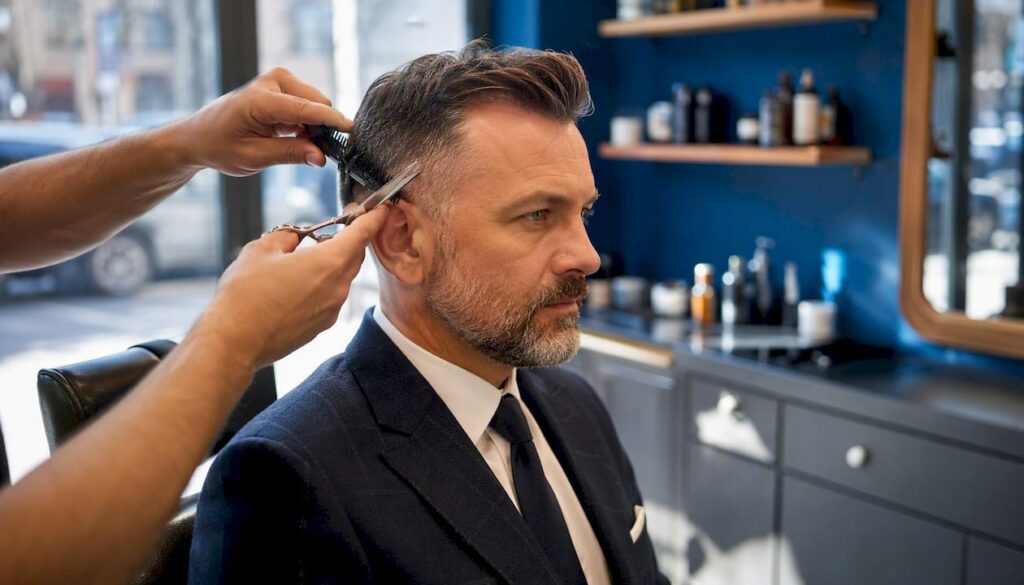
Most businessmen should schedule a haircut every 2–4 weeks to maintain a consistently sharp, business-ready appearance. The exact interval depends on your style: if you wear a fade or very short cut, every 2–3 weeks keeps the edges crisp. Blended crew cuts and short side parts hold well at 3–4 weeks. Medium-length professional styles can last several weeks before they start looking soft. Longer business styles, where the shape is less dependent on tight lines, can go 5–6 weeks. If your role allows a more relaxed outline, or your hair grows slowly, the outer edge of each range works fine. Rapid growers should always default to the shorter end.
- Fades and very short cuts: every 2–3 weeks
- Crew cuts and short side parts: every 3–4 weeks
- Medium-length comb-overs and blended styles: every 4–5 weeks
- Longer professional styles: every 5–6 weeks
Key Takeaways
Most businessmen who commit to a consistent haircut schedule every 3–4 weeks report sharper daily presentation, faster morning routines, and fewer last-minute grooming decisions before high-stakes meetings.
| Point | Details |
|---|---|
| Baseline interval by style | Fades: 2–3 weeks; crew cuts: 3–4 weeks; medium styles: 4–5 weeks; longer styles: 5–6 weeks. |
| Standing appointments remove friction | Pre-booking a recurring slot eliminates the decision and keeps you on schedule through busy periods. |
| Brief your barber clearly | Share your role, styling time, fade height, and desired interval so the cut is built to last, not just look sharp on day one. |
| Visual cue to act on | If styling takes more than five extra minutes versus day one, it’s time to book. |
| Phillythebarber for managed routines | Philly’s Barber Shop in Vesterbro offers standing appointments, saved client profiles, and executive grooming packages for professionals who want consistency without the effort. |
Table of Contents
- Why haircut frequency matters for your professional image
- Recommended haircut frequency by common business hairstyles
- Personal factors that change your ideal haircut schedule
- Quick visual cues that tell you it’s time for a cut
- Low-effort maintenance to keep your business cut working between visits
- How busy professionals schedule haircuts so grooming becomes automatic
- Exactly what to tell your barber so the cut holds longer
- What businessmen typically pay for regular haircuts
- How to maintain a professional look when you’ve missed a cut
- A barber’s perspective on cuts that last and what pros do differently
- Sharp grooming, handled: what Phillythebarber offers busy professionals
- Sources
Why haircut frequency matters for your professional image
A well-maintained haircut does something most professionals underestimate: it removes a variable. When your hair looks the same every Monday morning, you spend zero mental energy on it. When it’s grown out, you’re adjusting, compensating, and spending an extra five minutes in front of the mirror before a 7 AM call.
The business case is concrete. Research from an NYC executive grooming practice shows that most executives maintain cuts every 2.5–3 weeks, frequent visits annually, because high-visibility roles demand consistent presentation. Client-facing professionals and leaders are judged on appearance before they speak. A sharp haircut signals that you pay attention to detail, which is exactly the quality clients and colleagues want to see in someone managing their account or leading their team.
The operational upside is just as real. A fresh cut with the right shape requires minimal product and predictable styling. That “five-minute morning” grooming goal drives most cut choices for busy professionals: minimal product, reliable texture, and a shape that tolerates two weeks of growth without looking neglected.
Pro Tip: Schedule your haircut the day before a major presentation or client meeting so the cut is settled and fresh for the event window. The hair looks intentional rather than brand-new.
The cost framing is worth stating plainly. A haircut every 3–4 weeks at a quality barbershop is a small, predictable expense compared to the professional upside of consistent presentation. Spread across a year, it’s one of the highest-return grooming investments you can make.
Recommended haircut frequency by common business hairstyles
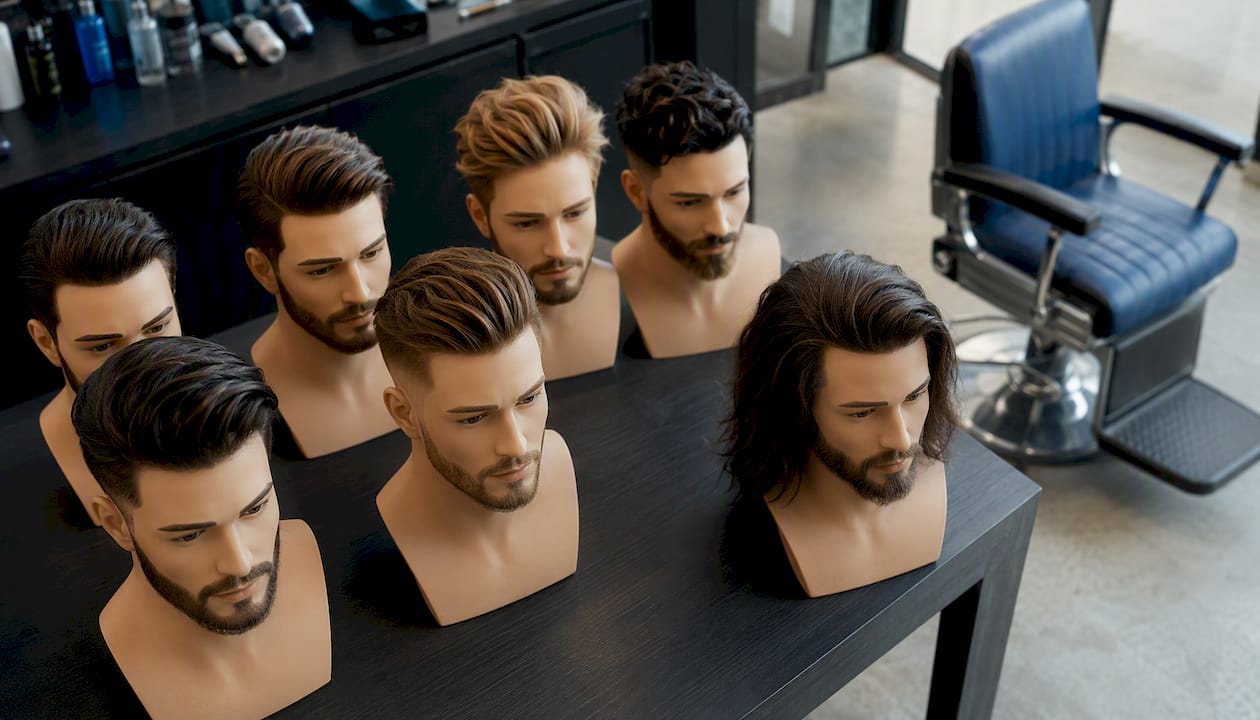
Barbers advising business clients consistently recommend booking every 3 weeks for maximum sharpness and every 4 weeks when a softer outline is acceptable. Here’s how that translates by style:
| Style / Length | Recommended Frequency | What It Preserves |
|---|---|---|
| Short buzz / bald fade | Every 2–3 weeks | Tight fade line, clean skin edges |
| Crew cut / short side part | Every 3–4 weeks | Shape at crown, defined side taper |
| Medium comb-over / blended | Every several weeks | Length proportion, blended sides |
| Longer professional styles | Every 5–6 weeks | Overall shape, manageable length |
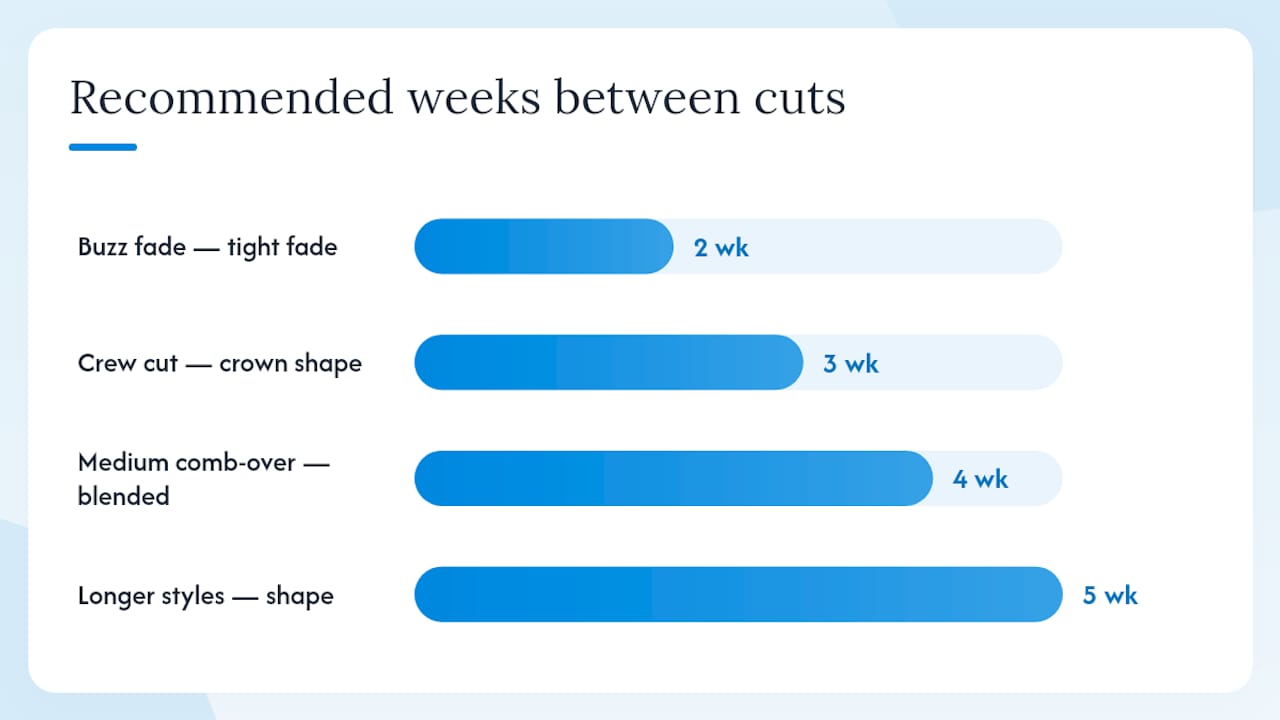
A fade is the most maintenance-intensive style in a business context. The fade line sits at a precise point on your head, and hair grows roughly half an inch per month. By week 3, the skin fade has softened noticeably. By week 4, the contrast that made it sharp is largely gone. GQ’s barber-sourced guidance puts short and fade styles at every 2–3 weeks, medium styles at every 4–5 weeks, and longer styles at 6–8 weeks for general wear. For a business context, pull those numbers toward the shorter end of each range.
The tradeoff with longer styles is different. You’re not maintaining a fade line; you’re managing overall shape and weight. A well-cut medium comb-over can look intentional through week 4 with the right product. By week 6, the sides start to look heavy and the part loses definition.
- Faster hair growth shortens every interval by roughly a week.
- Coarser hair tends to hold shape longer but looks bulkier when overgrown.
- Fine hair loses definition faster and often benefits from the shorter end of each range.
Personal factors that change your ideal haircut schedule
The style-based ranges above assume average hair growth. Your actual schedule depends on several variables that are worth mapping before you commit to a calendar slot.
Hair growth speed is the biggest lever. Average growth is roughly half an inch per month, but some men grow noticeably faster. If your neckline looks overgrown within two weeks of a cut, you’re a faster grower and should move to the shorter end of your style’s range.
Hair texture and density affect how quickly a style loses its shape. Coarse, dense hair holds a fade line longer but looks bulkier as it grows. Fine hair loses definition faster, especially around the temples and crown. Gray hair adds another layer: the contrast between gray regrowth and colored or darker hair at the temples becomes visible quickly, which matters in client-facing roles.
Role visibility is a practical filter. An executive who presents to boards weekly has a different tolerance for overgrowth than a developer who works remotely most days. Neither is wrong; they just need different intervals.
Use this quick checklist to decide whether to shorten or lengthen your interval:
- Do you wear a fade or skin cut? Move to the shorter end (2–3 weeks).
- Is your role client-facing or on-camera regularly? Shorter interval.
- Does your hair grow fast enough that your neckline looks rough within two weeks? Shorten by one week.
- Do you have a blended or longer style with no hard fade line? You can stretch toward the longer end.
- Do you have limited time for daily styling? A shorter, simpler cut on a tighter schedule saves more time overall.
Pro Tip: Try your baseline interval for two full cycles, then shift ±1 week and evaluate. Two cycles give your hair enough time to show you the real pattern, not just a one-off result.
Quick visual cues that tell you it’s time for a cut
You don’t need a calendar reminder if you know what to look for. These checks take about 30 seconds in front of a mirror.
- Crown and temple shape has softened. A well-cut style has a defined outline. When that outline starts to look rounded or uneven, the shape is gone.
- Fade edges are blending into skin. The contrast that made the fade sharp has faded. What was a clean line now looks like a gradual blur.
- Daily styling time has increased. If it takes noticeably longer to get your hair to sit right compared to the first week after a cut, the shape is working against you.
- Collar hair is touching your shirt. This is one of the clearest signals in a business context. Hair at the neckline touching your collar looks unkempt in a meeting room.
- Gray regrowth is prominent at the temples. For men with any gray, the contrast between fresh growth and the rest of the hair becomes visible quickly and reads as neglected in photos and video calls.
A simple rule of thumb: if it takes more than five extra minutes to style compared to day one after your cut, it’s time to book. The extra effort is the style fighting its own growth, not you doing something wrong.
Low-effort maintenance to keep your business cut working between visits
The goal between cuts is simple: slow the visual degradation without adding complexity to your morning routine. A few targeted habits make a real difference.
Daily routine: After showering, towel dry gently rather than rubbing aggressively. Rough towel drying disrupts the hair’s natural fall pattern and adds frizz. Comb or brush in the direction your style sits while the hair is still slightly damp. This sets the pattern before the hair dries.
Product selection: One product, chosen by purpose. For most business styles, a matte paste or light pomade applied to the mid-lengths and ends gives hold without shine that reads as overdone under office lighting. Apply to damp hair for a natural finish, or dry hair for more control. Avoid heavy waxes on fine hair; they weigh it down and make overgrowth look worse. For men’s grooming product options that match your specific style and texture, a quick consultation at the chair is worth more than any product label.
Neckline tidying: If you’re comfortable with a trimmer, a light pass along the neckline at the two-week mark can extend the clean look by several days. Stay conservative; only clean up stray hairs rather than trying to recreate the barber’s line.
Pro Tip: For travel, pack a small amount of your regular product in a travel-size container and a fine-tooth comb. These two items let you reset your style after a flight or a long day in a conference room. What you cannot fix yourself is the fade line or the shape at the crown — those need the barber.
How busy professionals schedule haircuts so grooming becomes automatic
The biggest reason businessmen miss haircuts isn’t cost or time. It’s decision friction. When booking requires active thought, it gets pushed. The fix is removing the decision entirely.
- Set a standing appointment. Choose your interval from the sections above, pick a recurring day and time that fits your calendar (early morning or lunchtime slots work well), and book it as a repeating event. Many executives prefer standing appointments or package deals specifically to remove this friction and maintain consistency across busy schedules.
- Anchor it to a recurring work event. Pairing your haircut with payday, the first Monday of the month, or your weekly team meeting creates a memory trigger that survives schedule changes.
- Use package deals or memberships. Pre-paying for a block of cuts removes the per-visit decision and often comes with priority rescheduling, which matters when a last-minute meeting lands on your appointment day.
- Build a travel buffer. If you travel frequently, design your cut to last through the trip. Book before you leave, not after you return. Some executive clients stretch to six weeks with the right cut built specifically for travel tolerance.
- Reschedule within 48 hours. When a conflict forces you to move an appointment, rebook immediately rather than waiting until the gap becomes obvious. A two-day delay is invisible; a two-week delay is not.
Pro Tip: Align your haircut with online booking so you can reschedule from your phone in under a minute when your calendar shifts. The less friction in the rebooking process, the more likely you are to stay on schedule.
Exactly what to tell your barber so the cut holds longer
A clear brief at the chair is one of the most underused tools in a professional’s grooming routine. Most men describe what they want visually but skip the maintenance context, which is the information a barber actually needs to build a cut that lasts.
Here’s a practical script you can use or adapt:
“I’m in a client-facing role and I want this to look sharp for about three weeks. I have about five minutes in the morning for styling. I’d like a [crew cut / comb-over / fade] with a [high / mid / low] taper. Keep the sides blended rather than too sharp so it grows out cleanly.”
The key technical details to cover:
- Clipper guard range on the sides (e.g., #1 on the skin fade, #2 on the taper)
- Fade height: low, mid, or high. A lower fade grows out more gracefully for longer intervals.
- Scissor-over-comb areas: ask for texturizing at the ends if your hair is dense; it reduces bulk as it grows.
- Neckline preference: squared, tapered, or rounded. A tapered neckline looks cleaner longer than a hard squared line.
Then confirm the plan explicitly: “I want this to last three weeks. Can you set it up for that?” A good barber will adjust the fade height and texturizing accordingly. Preparing for your barber visit with these details ready saves time at the chair and produces a more consistent result every visit.
Pro Tip: Ask your barber to note your preferences in your client profile. When your cut is documented, every visit starts from the same baseline rather than from a verbal description you have to repeat each time.
What businessmen typically pay for regular haircuts
Haircut pricing in the United States varies by market, shop type, and service level. At a standard barbershop in a mid-size city, a men’s haircut typically runs $25–$40. In major metro areas like New York, Chicago, or Los Angeles, quality barbershops commonly charge $45–$75 for a precision cut. Premium or executive-focused shops in those same markets can reach $80–$100 or more, particularly when the service includes a consultation, hot towel finish, or beard work.
For a businessman cutting every 3 weeks, that’s roughly 17 visits per year. At $50 per cut, the annual investment is around $850. At $75, it’s closer to $1,275. Package deals and memberships, which many executive-focused shops offer, typically reduce the per-cut cost by 15–25% while adding priority scheduling. That’s a meaningful saving for someone who values a guaranteed slot over a walk-in queue.
The value calculation is straightforward: consistent professional presentation, zero decision friction, and a morning routine that takes five minutes. For most businessmen, that’s not a luxury expense. It’s a professional operating cost.
How to maintain a professional look when you’ve missed a cut
Life moves fast. Sometimes the standing appointment gets pushed two weeks, and suddenly you’re heading into a board meeting looking less sharp than you’d like. A few targeted fixes can close most of the gap.
Product is your first tool. A light matte paste or pomade applied to damp hair can compress overgrown volume and restore some definition to a style that’s grown out. Apply it sparingly to the sides and work it through with a comb to push the hair back into its intended shape.
Comb direction matters more when hair is longer. A fine-tooth comb used on slightly damp hair can recreate a side part or flatten a crown that’s started to lift. This works best on straight to wavy hair; curly or coarse hair needs a different approach.
Dress up, not down. When your hair is slightly off, a sharper outfit compensates. A well-fitted suit or a crisp collar draws the eye and resets the overall impression. This isn’t a long-term strategy, but it works for a single high-stakes day.
A neckline tidy with a trimmer removes the most visible sign of overgrowth without requiring a full cut. Clean up the hairline at the back and around the ears, and the overall look improves noticeably. Stay conservative; a crooked DIY line is worse than a natural one.
For anything beyond these fixes, the right answer is to book a walk-in or same-day appointment rather than attempting a full reshape at home. A barber can restore the shape in 20 minutes; a DIY attempt can set you back further.
A barber’s perspective on cuts that last and what pros do differently
After 20 years behind the chair, I’ve noticed that the clients who always look sharp aren’t necessarily the ones who come in most often. They’re the ones who communicate clearly and let me build a cut that’s designed to grow out well, not just look good on day one.
The technical choices that extend a cut’s life are specific. A lower fade placement grows out more gradually than a high skin fade, which means the contrast softens slowly rather than disappearing overnight. Graduated layering on top reduces bulk as the hair grows, so the shape stays proportional longer. Texturizing at the ends, done with scissors rather than a razor, gives the hair movement that reads as intentional even at week three or four. These are the techniques I use with executive clients who need cuts that survive a two-week business trip, as barber practitioners confirm: a cut built for longevity requires tailored shaping choices, not just a standard trim.
The other piece is documentation. When your preferences are saved in a client profile, every visit starts from a known baseline. I know your fade height, your neckline preference, your product tolerance, and how your hair behaves at week three. That consistency is what makes the cut repeatable, and repeatability is what makes a grooming routine effortless.
Pro Tip: Book your haircut 2–3 days before a major business event, not the day before. Hair needs a short settling period to relax into its natural texture. A cut done 2–3 days out looks intentional and camera-ready; one done the morning of can look stiff in photos.
One more thing I tell every new client: why men seek expert barber guidance isn’t just about the cut itself. It’s about having a professional who understands your schedule, your role, and your hair, and builds a plan around all three.
Sharp grooming, handled: what Phillythebarber offers busy professionals
The difference between a grooming routine that works and one that doesn’t usually comes down to one thing: whether it’s built around your schedule or you’re constantly fitting into someone else’s.
At Phillythebarber, Philly’s Barber Shop in Vesterbro, Copenhagen, we build grooming routines around busy professionals. Standing appointments mean your slot is reserved before you even think about it. Client profiles save your cut details, fade height, and neckline preferences so every visit produces the same sharp result. For executives who travel, we build cuts designed to hold through a two-week trip. For professionals who want a complete grooming experience, our full-service grooming packages combine haircuts, beard trims, and straight razor finishes in a single efficient appointment. Ready to make your grooming routine automatic? Book your standing appointment and let us handle the rest.
Sources
The recommendations in this guide draw on barber-sourced frequency ranges, executive grooming practice data, and scheduling guidance from professional barbershops across the United States. The sources below represent the primary references used to build the style-by-style schedule and booking strategy.
- Business professional haircut for men guide | MenHair
- The modern executive’s guide to polished grooming in Fairfield | The Warehouse Salon
- Here’s how often you should really be getting your hair cut | GQ
- Professional Haircuts for Business Executives: 2026 Queens NYC Guide
- Business haircut Manhattan: Maintain your professional edge – Village Cuts NYC
- Professional haircuts for men | Barberstake
- How often to get a haircut? | The Rosemont Barbers
For deeper reading on grooming routines and product selection, the men’s grooming best practices guide at Phillythebarber covers maintenance, product choices, and quick styling routines in detail. Author expertise: Philly is a certified Master Barber with over 20 years of experience, specializing in executive grooming and precision cuts at Philly’s Barber Shop in Vesterbro, Copenhagen.